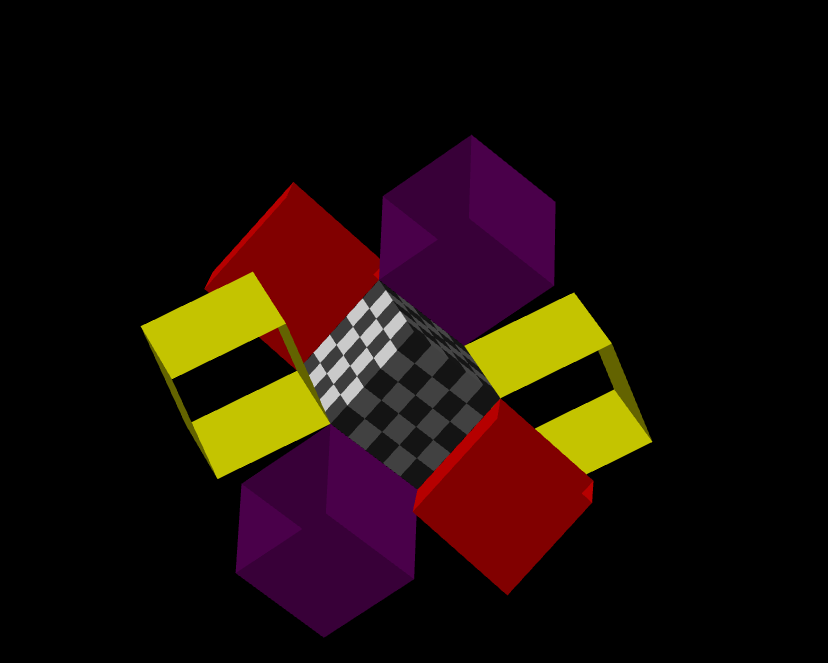
CyberMath is a shared virtual environment for exploring mathematics. I've long wanted to make Graphing Calculator into an authoring tool for such an interactive immersive space. The popularity and success of World of Warcraft hints at the possibilities in coming years.
Does anyone here use Second Life or have any knowledge of Croquet? The technology for building these spaces is maturing. I'm now wondering how to make it accessible to teachers and curriculum authors so that they can focus on the mathematical content and pedagogy while constructing mathematical landscapes.
I would welcome any advice.
Kudos to Astropixie for pointing out the images!
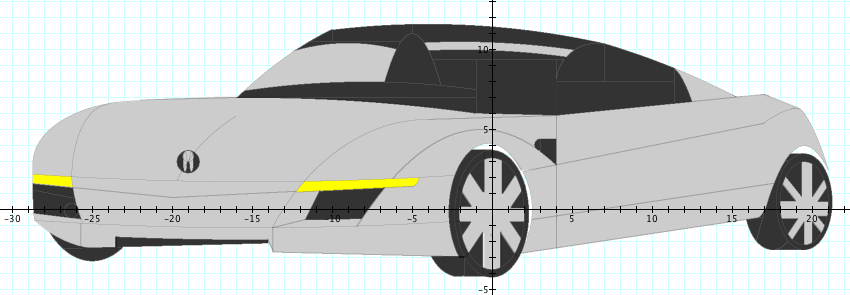
Nico Bakker sent in this document saying Here is another example of the beauty of Graphing Calculator.
Thank you, Nico!

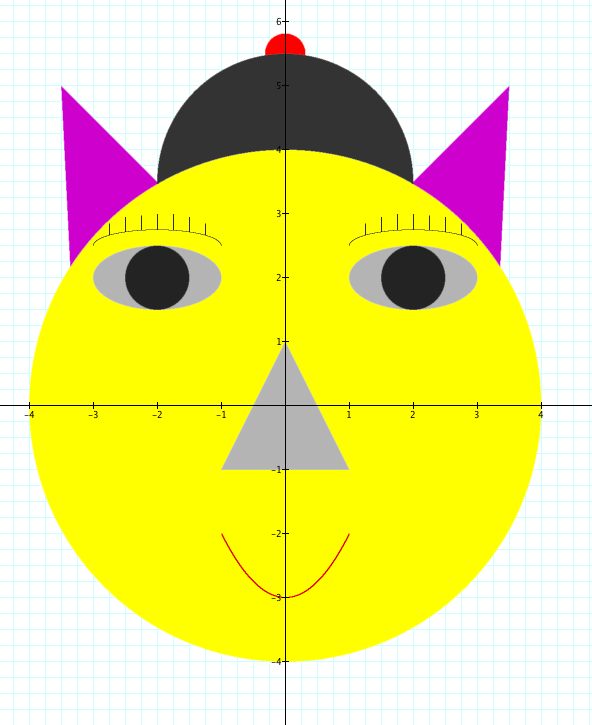
Click the image to see the equations.
Click here for the movie.Mattel got a lot of flack for its talking Barbie doll which said "Math is hard." I wanted to reprogram the voice chips to say "Partial differential equations with Neumann boundary conditions are hard." It's not that I completely disagreed with Mattel, I just thought Barbie should have been more specific. Imagine the conversations: "Mommy, what's a Neumann boundary condition?" "Well you see dear, that's when you fix the value of the derivative on the boundary curve." But then, I've been working on nerd propaganda for decades.
I clicked "Restart" after Apple Software Update applied what I thought were minor system patches, and my computer rebooted into Windows....
Over the past few years, the hardware-accelerated rendering pipeline has rapidly increased in complexity, bringing with it increasingly intricate and potentially confusing performance characteristics. Improving performance used to mean simply reducing the CPU cycles of the inner loops in your renderer; now it has become a cycle of determining bottlenecks and systematically attacking them. This loop of identification and optimization is fundamental to tuning a heterogeneous multiprocessor system; the driving idea is that a pipeline, by definition, is only as fast as its slowest stage. Thus, while premature and unfocused optimization in a single-processor system can lead to only minimal performance gains, in a multiprocessor system such optimization very often leads to zero gains. - Cem Cebenoyan, NVIDIA, in GPU Gems